
Scaling Cooperative Mobile Multi-Robot Systems
| Led by: | Tobias Recker |
| E-Mail: | Recker@match.uni-hannover.de |
| Team: | Tobias Recker |
| Year: | 2018 |
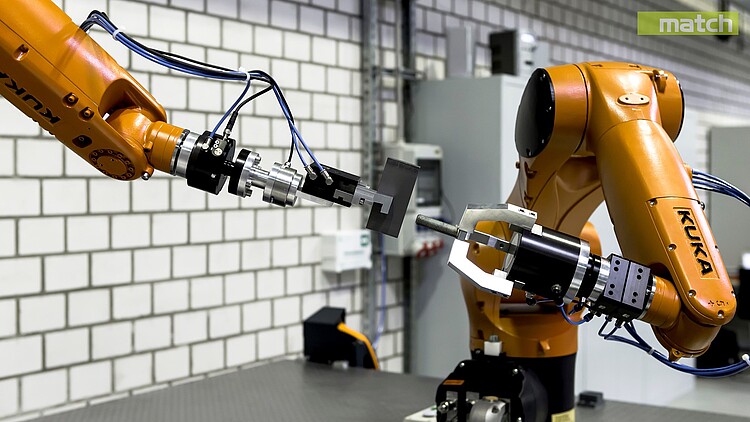
Large, heavy, and highly variable components place demanding requirements on automated handling and assembly processes. We investigate cooperative mobile multi-robot systems in which several mobile manipulators jointly perform transport, positioning, handling, and assembly tasks.
Through coordinated cooperation, the robots can flexibly combine their forces, motions, and workspaces. The number, arrangement, and task allocation of the involved systems can be adapted to different components and process requirements. This enables scalable solutions for cooperative object transport, precise handling, and load-adapted assembly of large-scale components.
Our research focuses on scalable programming and planning methods, decentralized control approaches, and reliable coordination of the individual robots. Local sensing allows the systems to directly perceive motions and occurring loads and to react accordingly. Higher-level commands ensure that the overall system follows common objectives, process limits, and safety requirements.
To achieve this, we combine model-based methods from robotics, control engineering, and assembly technology with learning-based approaches. While classical methods are used, for example, for motion control and collision avoidance, data-driven models can represent complex contact and force interactions. This is particularly relevant for assembly processes in which several robots interact simultaneously with a component and its environment.
Our goal is to develop reconfigurable multi-robot systems that can be programmed efficiently, transferred to different system configurations, and applied to flexible manufacturing processes down to batch size one. In this way, we lay the foundation for flexible, robust, and scalable automation of the handling and assembly of large components.